Petty · Character AI · 2026
Petty — Your Story, One Conversation at a Time
Meet a character and create the next scene together.
Visit Service
Project Overview
Petty is an AI character conversation app for roleplay and storytelling. It connects character and story context, conversation memory, and reply suggestions. Responses stream from an OpenRouter-backed model across the web and mobile experience.
A conversation with a next scene
Petty is less about asking a question and receiving an answer than continuing a story with a character. A consistent voice, a recognizable setting, and a connection to earlier conversations help make the next scene worth discovering.
I am building the journey from finding a character to chatting and returning to saved history. Planning, design, development, and operations are handled independently.
Starting with a character
Users choose a character and story, then begin a conversation within that setting. They can return to previous conversations or regenerate a response to explore another direction.
Reply suggestions and choices provide a way forward when it is difficult to decide what to say. They use recent conversation context and accumulated memory rather than unrelated prompts.
Fast delivery, comfortable reading
Conversation generation uses an OpenRouter-backed model. Lambda verifies authentication and conversation ownership before sending content over SSE, then persists the completed message and state.
Model output and reading speed are different concerns. The UI has a separate display queue: the beginning appears immediately, and the rest continues at a readable pace. Server persistence and completion do not wait for that animation.
This lets me address time to first text separately from the problem of a large block arriving all at once.
Keeping longer conversations coherent
A long history cannot all be sent to the model unchanged. Recent messages are combined with accumulated memory, and regeneration preserves previous response versions.
Output language and speaker markers are checked separately. These checks help reduce unexpected language changes and keep displayed text aligned with what is saved.
Failed or interrupted turns remain distinct from completed conversations, and usage handling follows those states. The experience depends on reliable history and state as well as generated prose.
Shared foundations for web and mobile
The app uses a Next.js static export and Capacitor, connected to an AWS serverless data and authentication backend. TanStack Query and Zustand separate server data from screen state.
Provider calls and transport sit behind a conversation contract. Screens work with messages and stream events, while adapters connect models and persistence. Changing a model should not require rewriting the conversation UI.
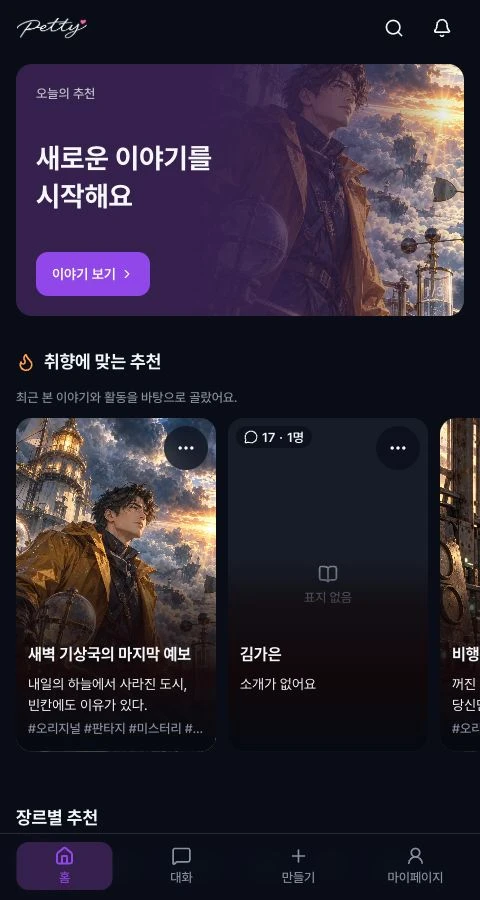
Live story discovery screens
The current app’s home and a public story detail page, showing discovery and review before starting a conversation. Screens show the Korean app.

Related engineering notes
Improving Petty Character Chat: Memory and a Story That Continues
How Petty is refining long-term character memory and making replies, speaker bubbles, and suggested responses feel more natural.
Agentic Workflow Architecture: How to Run AI Agents as a Product
Model quality matters, but execution structure matters more. This post lays out a practical framework for designing agentic workflows around decomposition, routing, state, and observability.
Designing Agent Observability: Leave Improvement Loops, Not Just Logs
When coding agents become part of team operations, prompts are not enough. This guide shows how to connect traces, decision logs, evals, and regression checks into an improvement loop for AI-native development.